
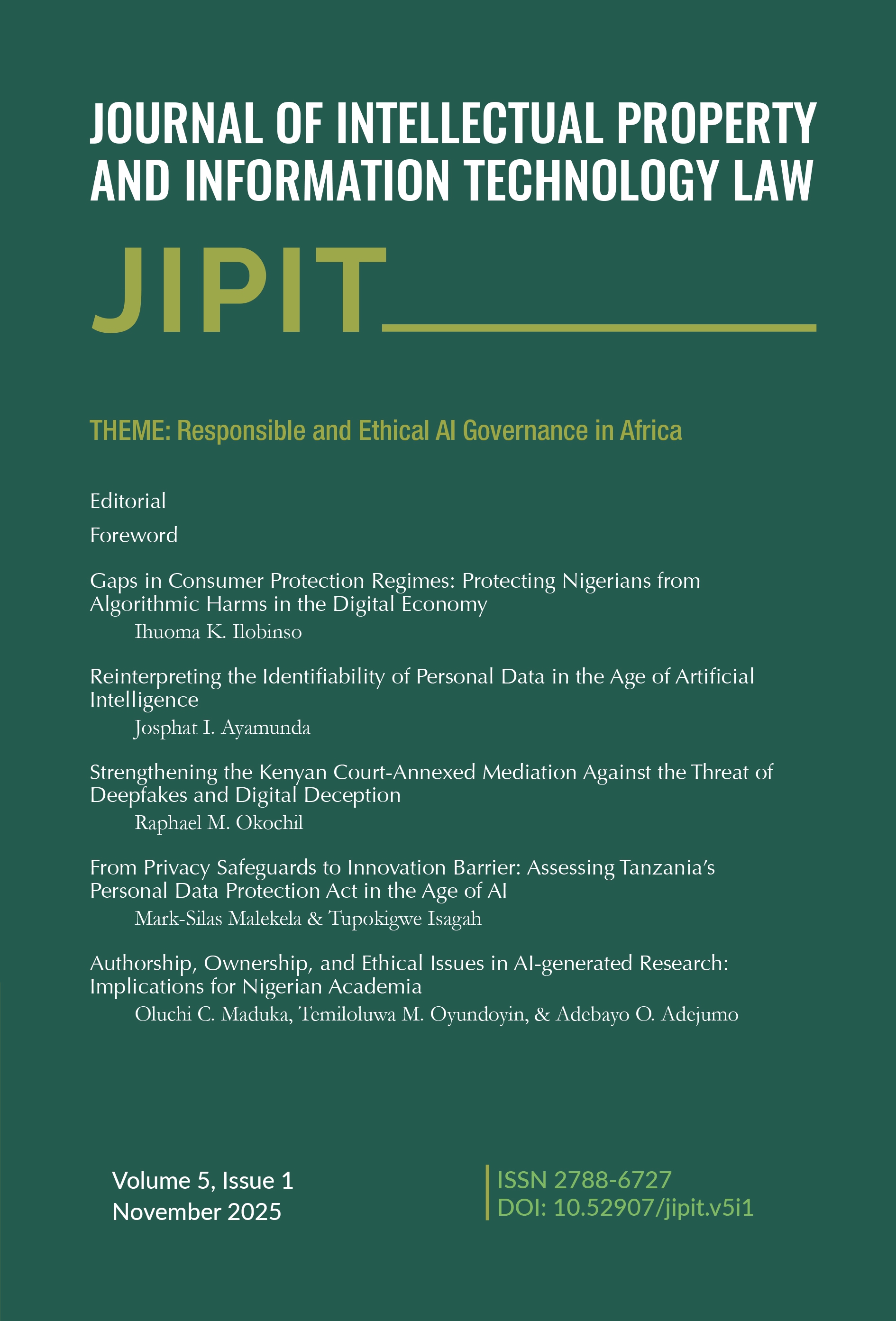
Strengthening the Kenyan Court-Annexed Mediation Against the Threat of Deepfakes and Digital Deception
DOI:
https://doi.org/10.52907/jipit.v5i1.624Keywords:
Artificial Intelligence, Deepfakes, Digital Ethics, Mediation, Synthetic EvidenceAbstract
This paper explores how Kenya’s mediation framework, particularly the Court-Annexed Mediation (CAM) system, can adapt to an era where fabricated evidence (such as Artificial Intelligence (AI) generated deepfakes and distorted digital documents) threatens the principles of truth, trust, and fairness, which are essential elements in Alternative Dispute Resolution (ADR). This analysis focuses on mediation due to its distinctive vulnerabilities: its inherent informality, the absence of formal evidentiary rules, and the mediator’s non-adjudicative role, all of which make it exceptionally susceptible to manipulation by synthetic media. Relying on Kenya’s Civil Procedure (Court-Annexed Mediation) Rules, 2022, the Evidence Act (Cap. 80), and emerging local jurisprudence, this paper examines how the law treats digital and synthetic evidence in ADR. Further, this paper relies on interdisciplinary literature from cognitive psychology and digital ethics to frame the challenge. Thus, the author addresses several sub-themes, such as the ‘illusion of truth’, the cognitive tendency to believe convincing fakes, and the ethical and procedural challenges that arise when fabricated information enters the dispute resolution process. Additionally, the author explores the promises and shortcomings of technologies such as AI-assisted tools for detecting such forgeries, considering their practical (in)accessibility to Kenyan mediators. To this end, this paper argues that the future of mediation in Kenya requires mediators to become more vigilant facilitators, armed with digital awareness and supported by frameworks that enable them to broker peace in an era where appearances no longer guarantee reality. This paper proposes a set of integrated reforms by examining the evolving nature of evidence and human judgment within the facilitative process. It also proposes institutional safeguards to be deployed when handling digital materials.
Downloads
Published
Issue
Section
License
Copyright (c) 2025 Raphael Okochil

This work is licensed under a Creative Commons Attribution 4.0 International License.


