
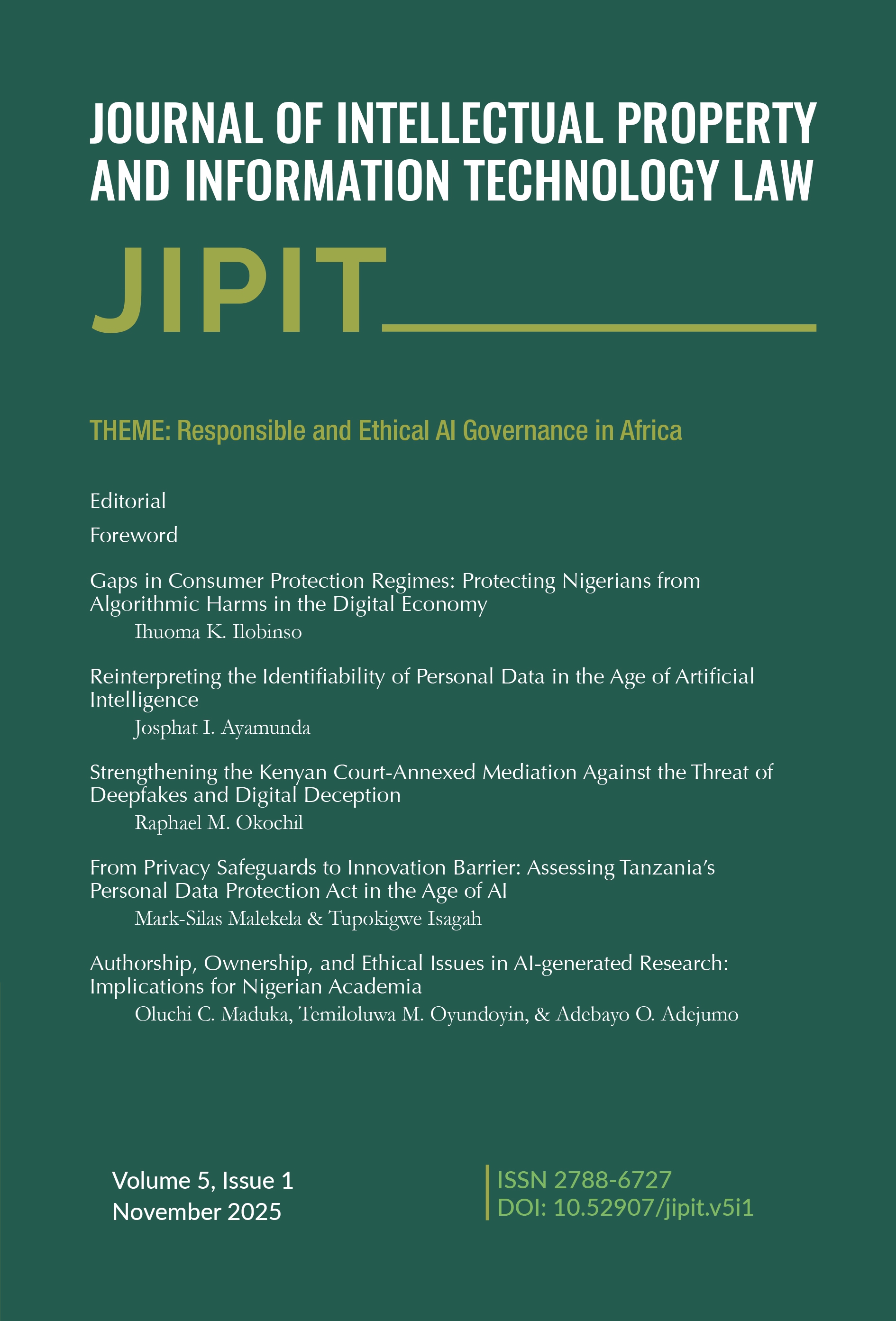
Authorship, Ownership, and Ethical Issues in AI-generated Research: Implications for Nigerian Academia
DOI:
https://doi.org/10.52907/jipit.v5i1.520Keywords:
AI-generated Research, Authorship, Ethics, Ownership, NigeriaAbstract
As generative Artificial Intelligence (AI) systems continue to transform academic research, debates over their appropriateness within the academic community continue to garner global attention. These debates are exacerbated in the Global South, where limited access to AI infrastructure and slow adoption of ethical AI guidelines heighten vulnerabilities. Previous studies in Nigeria have largely examined the use of AI in academia from an empirical perspective, focusing on assessing students’ and academics’ levels of awareness, attitudes, and perceptions toward tools such as ChatGPT. While these studies provide valuable insights into patterns of use and acceptance, they pay little attention to the doctrinal interpretation of authorship and ownership under copyright law, issues that become increasingly complex when research outputs are generated with or by AI. Drawing on global contexts, this paper aims to fill this gap by critically analyzing how existing copyright principles of authorship and ownership apply to AI-generated academic works in the Nigerian context. The paper finds that Nigerian copyright law remains human-centric, recognizing only works demonstrating human creativity and originality. A distinction is emerging between AI-generated and AI-assisted works: while wholly AI-produced outputs lack protection, those involving meaningful human input—such as prompting or creative direction—may attract authorship and by extension ownership. Thus, students or researchers who apply intellectual effort in using AI tools can still be deemed authors. Ultimately, the challenge is not whether AI belongs in academia, but how to shape its presence in ways that uphold human creativity, accountability, and justice. Therefore, Nigerian universities and regulators must develop codes of conduct, establish AI ethics committees, and align with global authorship standards to ensure ethical use of AI while promoting equitable access to AI infrastructure.
Downloads
Published
Issue
Section
License
Copyright (c) 2025 Oluchi Maduka, Temiloluwa Oyundoyin, Prof. Adebayo Adejumo

This work is licensed under a Creative Commons Attribution 4.0 International License.


